
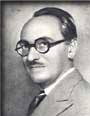
 In May 1955, André Claude died, born the same year as my father, and who was the President of the Students’ Association just before him (as early as 1922). With his loss, it was also the end of an adventure, a friendship, and even a brotherhood from before the war, of a common fight to help students eat, to find accommodation, and to be treated medically, for free, or for very little.
Nephew of the genial Georges Claude (alas, scientific advisor under Marshal Pétain), director of Air Liquide, ex-President of the Association of Lighting Engineers, André Claude, born in Algeria on the 1st January 1900 (my father was born the 3rd of January, they were almost twins) produced the neon tubes invented by his uncle, and was a pioneer in the use of rare gases (krypton, neon, xenon). He worked also, following his uncle, on ways to harness the thermal energy of the earth and the sea.
« Everywhere, natural or artificial, light can be a source of inspiration and beauty, taking the most mysterious roundabout in our sensibility. Its gives, at home or at work, more comfort and happiness. » (André Claude)
After the first city lightening in Paris, in 1933, he took part in most of the international demonstrations, as in1935, at Brussel’s International Exhibition, where fluorescent lighting was used spectacularly both inside and outside the pavilions. He was there in 1937, in Paris, when the vault of the Eiffel Tower was transformed into a giant chandelier, and in the same year, the Automobile Show was exclusively lit by fluorescent tubes. In 1939, for the Exhibition in New York, André Claude sent a light fresco with 600 metres of fluorescent tubes, in pastel shades. From that time, American engineers began to be interested in fluorescent lighting, which was a French invention.
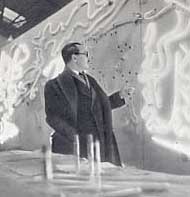
« André Claude was a fine gentleman. A great physicist, an incomparable director, he was for me, above all, a sensitive soul and an artist. He believed very much in the positive role played by light in human lives, and any progress made in that direction was his passion.» (André Granet, Chief-Architect of State Buildings).